
Customer Checkout: gymker's Original Accounting Concept for Gym Studios
Almost every studio discounts its cards, but most systems can't tell you which session — or which day — the member's payment is actually "used up." gymker pins it down to the cent and to the day with an original concept: the Customer Checkout.
What this article covers: Almost every studio discounts its cards, but the money the member actually paid — when exactly is it “used up”? Most systems have no idea. gymker solves it with an original concept — the Customer Checkout — accurate to the cent and to the day.
- What the Customer Checkout is, and why it protects the studio
- Session-pack PT: settling on a specific session number
- Annual membership: settling on a specific date
- Customer Checkout + Dual-Track Accounting = the studio’s ace in the hole
Almost nobody buys a card at list price. Annual cards at 20% off, buy-more-get-more on PT, group-buy pricing, referral discounts… discounts grease the deal, and that’s fine. The problem is what comes after —
- A member who has taken twenty-something sessions wants a refund — do you go by the list price, or the amount they actually paid after the discount?
- That amount they actually paid — on which day, or which session, has it been “consumed in full”?
- If a dispute escalates, what proof do you have that “we have already delivered as agreed, and the customer is fully settled”?
Most scheduling software hits a wall right here. It only tracks “how many sessions bought vs. used” — there’s simply no ledger for “where did the money the member actually paid get consumed.” So refunds are guesswork, disputes are arguments, and the cost of every discount you gave away ends up as a black hole on the books.
gymker solves this with an original accounting concept — the Customer Checkout.
1. What is the “Customer Checkout”
Core definition: Customer Checkout = the amount the member actually paid, drawn down session by session at the standard (undiscounted) price, until it hits zero on a specific session or a specific day.
The essence of this rule: the member’s payment was discounted, but the system draws it down at the standard price, not the discounted one.
Why design it this way? Because this is precisely what protects the studio:
- The discount the member enjoyed is a concession the studio chose to give; it has no business polluting the redemption ledger;
- Residual value is always drawn down at “what this session is actually worth” (standard price);
- When the discounted amount paid has been drawn down to zero at the standard price — at that moment, the studio’s contractual obligation to this member, in monetary terms, is fully discharged.
After the Customer Checkout, the member may still have a few sessions left, the card may not have expired — those are the benefits the discount “bought” them. But on the books, and contractually, the customer is already settled.
Let’s look at how gymker pins this down to the cent and to the day, using the two most common products.
2. Session-Pack PT: settling on a specific session number
A typical PT order:
| Item | Value |
|---|---|
| Per-session standard rate | ¥480 / session |
| Quantity purchased | 24 sessions |
| Gross price | ¥480 × 24 = ¥11,520 |
| Amount paid after discount | ¥10,000 (concession of ¥1,520) |
The system draws down residual value at the standard rate of ¥480/session, subtracting from the ¥10,000 received one session at a time:
| Progress | Calculation | Residual | Status |
|---|---|---|---|
| After session 19 | 10000 − 480×19 | ¥880 | Enough for one more |
| After session 20 | 10000 − 480×20 | ¥400 → zeroed | ⬅ Customer Checkout |
⚠️ A subtle detail people get wrong: residual goes to zero as soon as the remaining ¥400 can’t cover the next session’s ¥480 — not when it goes negative. So the Customer Checkout is session 20, not session 21.
What this means: the member is entitled to all 24 sessions, but their money is contractually settled at session 20; the ¥1,520 concession ≈ four extra sessions given away — the studio knows it, and has it on the books. If a refund comes up on any day, the system hands you the customer-facing residual and the Customer Checkout, fully traceable.
Here’s what this order actually looks like inside gymker:
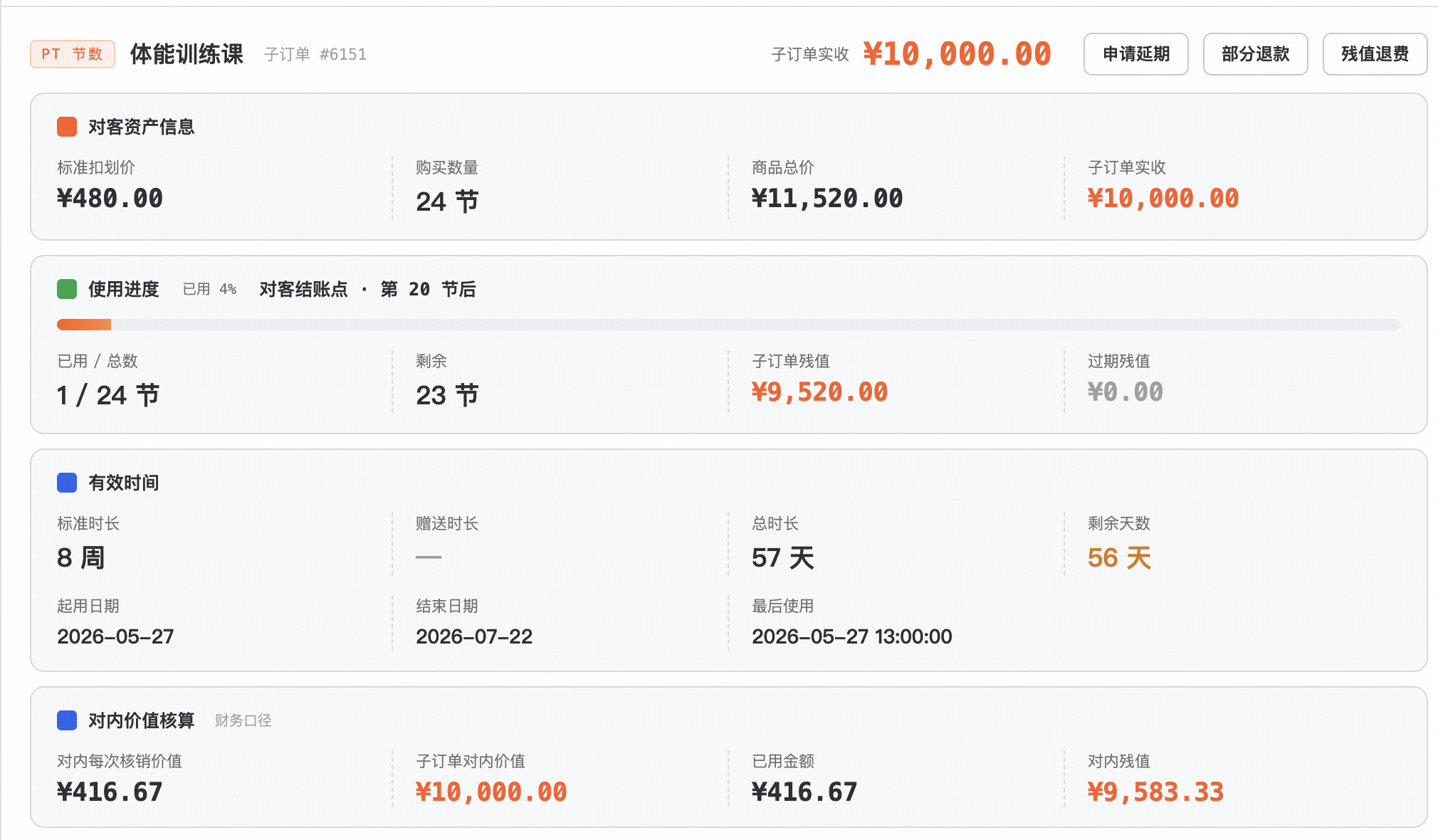
Top row: standard rate ¥480, 24 sessions purchased, gross ¥11,520, received ¥10,000. “Usage progress” displays Customer Checkout · after session 20 directly, with sub-order residual ¥9,520. At the very bottom, the “Internal-Track Value Accounting” panel is laid out side by side — that’s the other ledger, covered below.
3. Annual Membership: settling on a specific date
Time-based cards sell a “period of time,” and gymker pins those down to which day they settle too. Same logic: residual draws down at the standard daily rate, and because the amount paid was discounted, it zeroes out before the card actually expires.
A 20%-off group-buy annual card:
| Item | Value |
|---|---|
| Annual card standard price | ¥3,880 |
| Validity | 365 days |
| Standard daily rate | ¥3,880 ÷ 365 ≈ ¥10.63 / day |
| Amount paid (20% off) | ¥3,104 (concession of ¥776) |
Residual starts at ¥3,104, drawing down ¥10.63 per day, and hits zero around day 291 — that is, from activation date 2026-04-03 forward to 2027-01-19. The card itself expires 2027-04-02, so the member can still use it for another ~74 days, but the customer is already settled.
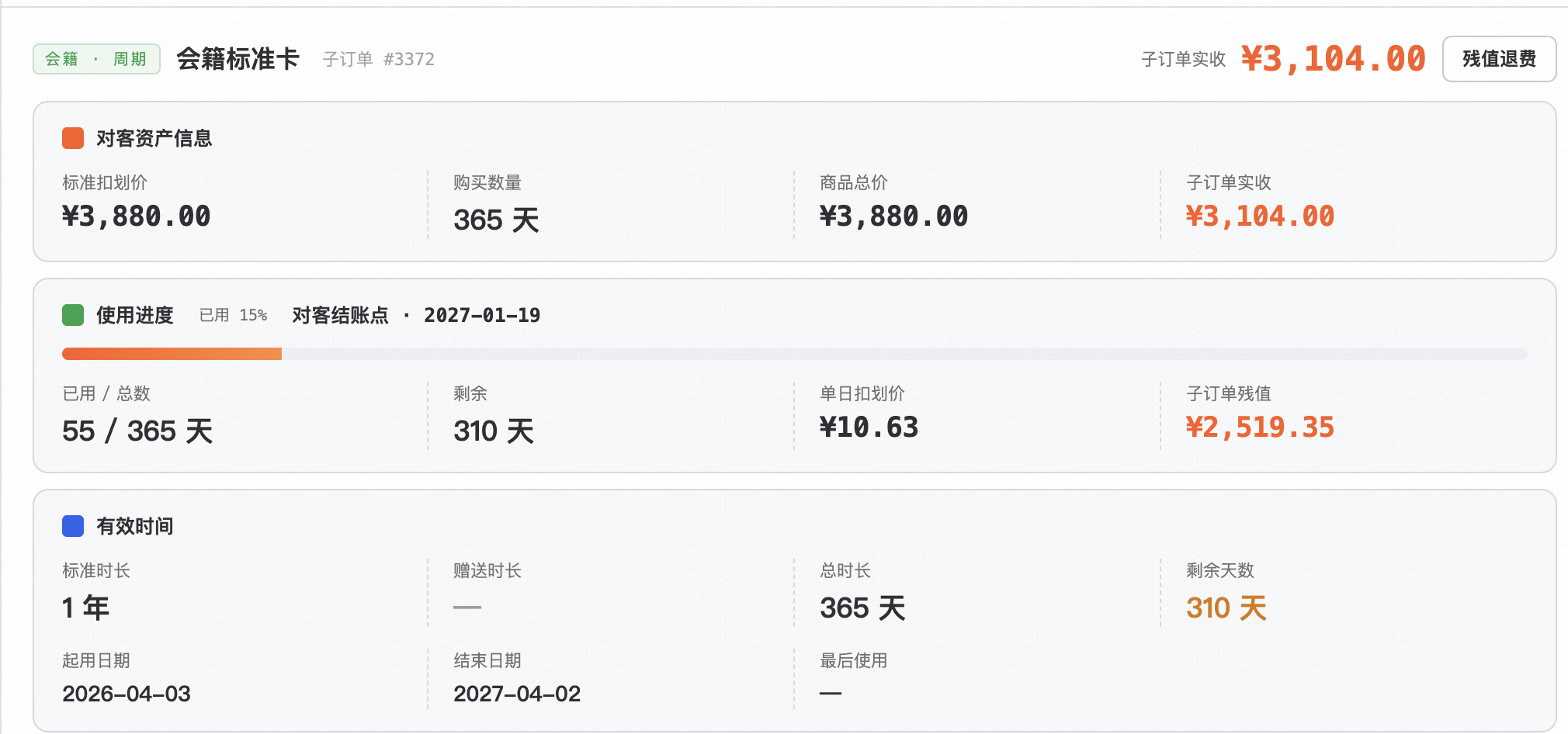
Received ¥3,104, standard price ¥3,880, “Usage progress” shows Customer Checkout · 2027-01-19, daily rate ¥10.63, sub-order residual ¥2,519.35. The member bought a one-year card, but the money is settled more than two months before expiry — those 74 days are what the 20% concession bought, and the studio has crystal-clear visibility into it.
4. Customer Checkout + Dual-Track Accounting = the studio’s ace in the hole
The Customer Checkout doesn’t stand alone — it works in combination with gymker’s Dual-Track Accounting (customer-facing + internal-track):
| Customer-Facing (P2C) | Internal-Track (P2I) | |
|---|---|---|
| Audience | Member / contract / refund | Studio itself / cost / sales credit |
| Logic | Amount paid drawn down at standard price, settled at Customer Checkout | Recognized on actual delivery, not polluted by concessions |
| Value | Refunds defensible, contracts hold up | Costs accurate, profit visible |
Remember the “Internal-Track Value Accounting” panel at the bottom of that PT screenshot? Internal redemption is ¥416.67 per session, internal residual ¥9,583.33 — sitting side by side with the customer-facing ¥9,520. Two ledgers, each computed on its own logic, with the difference visible at a glance. That gap is exactly where the studio’s operating insight lives.
Summary · three benefits for the studio
① Redemption that’s real and verifiable — every redemption corresponds to actual delivery and an actual amount, not estimates, not guesses.
② Refunds and contract disputes that hold up — at any moment, the system tells you “where this member’s money has been drawn down, and whether the customer is fully settled” — that’s real explanatory power at the contract and regulatory level.
③ Real leverage for the studio — how much concession was given, and through which session — every cent is traceable. The studio gives discounts with full visibility, and no longer takes losses without knowing it.
5. Why this is rare
The vast majority of scheduling software has only “sessions / days” in its ledger — no independent redemption line for “the money the member actually paid.” It conflates “how much was sold” with “how much should be redeemed” — discount goes in at face value, concession costs have nowhere to land, and refund amounts are estimated by hand.
gymker separates these two things at the foundation: one track for the customer (amount paid, Customer Checkout), one track for the studio (standard price, actual delivery). Two tracks running in parallel, each independently traceable.
The Customer Checkout is a concept and algorithm we originated. We won’t claim others have never had similar ideas, but turning it into a working system — accurate to the cent and to the day, traceable in parallel with internal-track accounting — is something gymker designed from the ground up and refined through iteration.
You can give discounts. You can’t have fuzzy books. gymker gives you the clarity to account for every cent and explain every line.