
Create → Pipeline: Closing Every Order Cleanly
Many owners think "the customer paid, so the deal is done" — that's a sales mindset. To last, you need an operations mindset: closing every order without a leak. gymker's Create → Pipeline workflow gets it done in three steps.
What this article covers: Many owners think “the customer paid, so the deal is done” — that’s a sales mindset. If you’re in this for the long haul, you need an operations mindset: closing every order without a single leak. gymker’s original Create → Pipeline workflow uses three steps to make every order complete.
- Sales mindset vs. operations mindset
- Creating ≠ completing — the pipeline is what matters
- Three pipeline steps: payment confirmation / contract / sales attribution
- Building the workflow into the system as a “gate”
A lot of owners run their business on one deep-seated belief —
“Once the customer paid, the deal is done.”
That’s a sales mindset: at the moment of close, the logic is sealed; the rest is just attending, redeeming, renewing.
But if a studio is in this for the long haul, what it needs is an operations mindset — closing every single order without a single leak is what matters.
Money received is just the opening line of an order. There are three things that, if not done, leave the order incomplete:
- Processing fees not reconciled — a fraction of a percent eats tens of thousands of yuan in profit per year;
- Contract not signed — when a dispute hits, you don’t have a single piece of paper to wave;
- Sales credit not allocated — the person who brought you this deal won’t sell the next one.
Across the industry, almost no system forces you to finish all three — most SaaS marks the order “successful” the moment payment lands.
gymker doesn’t. We deliberately designed an original workflow — Create → Pipeline.
1. Creating ≠ completing — the pipeline is the core
Core definition
Create = constructing the order: what product the customer buys, how much bonus period is gifted, what discount is given.
Pipeline = moving the order from “constructed” to “actually closed”: payment confirmation → contract signing → sales attribution, no step skippable.
This isn’t just a few database fields — it’s a workflow. gymker turns every step into a mandatory “gate” in the system: until you’ve cleared all of them, the order sits in “creating” status, and the card doesn’t activate, sales credit doesn’t enter statistics, and check-ins will fail.
Sounds like a hassle? That’s exactly the design intent — let the system enforce operational completeness on your behalf.
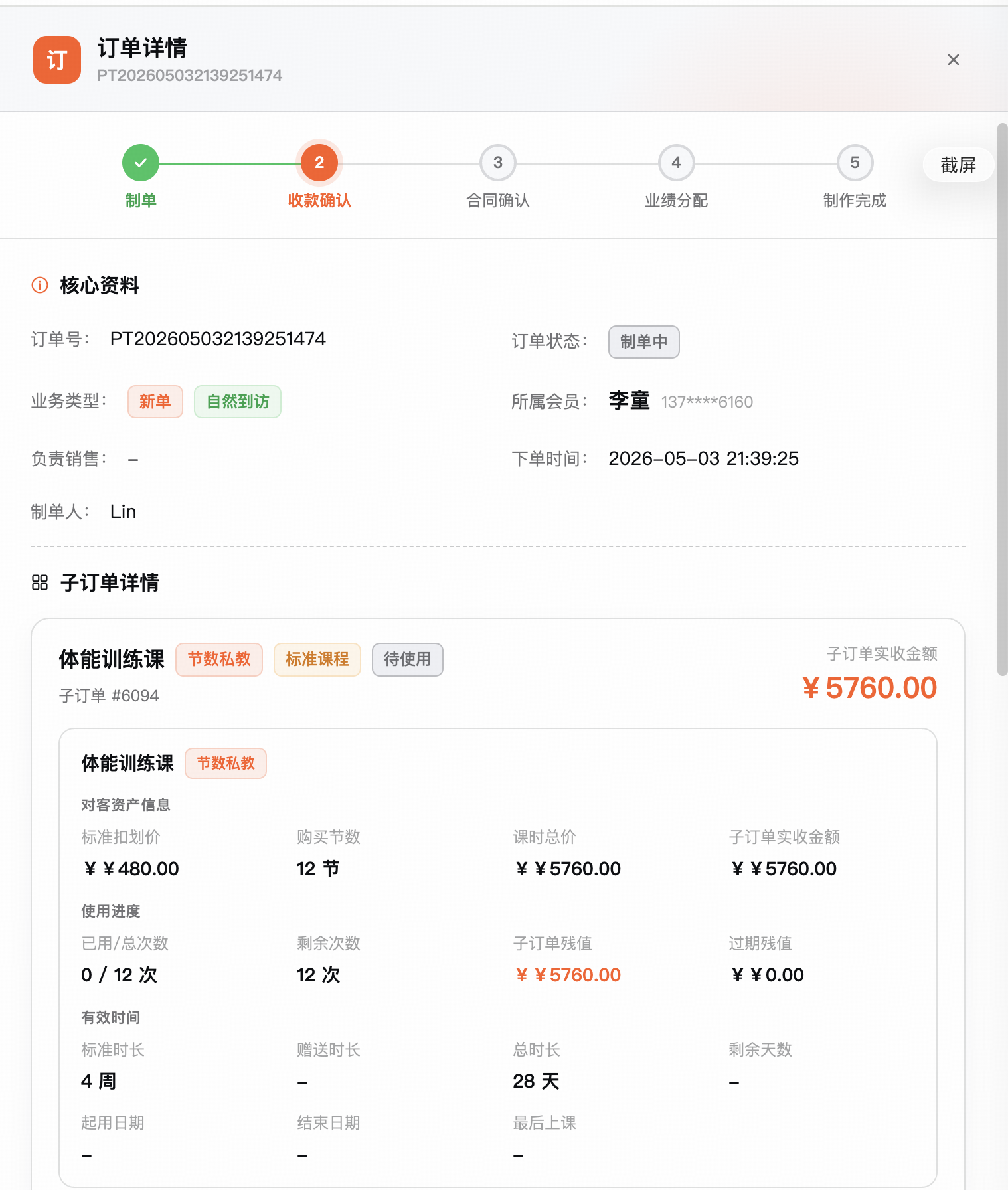
Look at this order detail: ✓ Order Created → ② Payment Confirmation (currently stuck here) → ③ Contract Confirmation → ④ Sales Attribution → ⑤ Creation Complete. The order status reads “creating” — meaning that even though ¥5,760 has been placed against this sub-order, the card hasn’t truly activated, and check-ins, sales credit, and revenue statistics all stay out. The system won’t let you skip a step.
2. Pipeline step one: payment confirmation — don’t let “small money” eat your profit
Payment processing fees look like rounding errors, but they’re real erosion:
| Annual collection volume | Fee rate | Annual cost |
|---|---|---|
| ¥2M | 3.8‰ (typical aggregated payment) | ¥7,600 |
| ¥2M | 6‰ (some SaaS-bundled online payment) | ¥12,000 |
| ¥10M (multi-store total) | 3.8‰ | ¥38,000 |
| ¥10M | 6‰ | ¥60,000 |
Bumping the rate from 3.8‰ to 6‰ alone costs you ¥22,000 more per year — and this difference is completely outside your line of sight, because almost no owner has the patience to reconcile transaction by transaction.
Worse still: manual reconciliation is brutally draining. Dozens to hundreds of collections per day — who paid, through which channel, how much fee got deducted, did it land — burn a week on Excel and you still might not balance.
gymker’s solution:
- End-to-end automation: scan → entry → automatic fee reconciliation → deposit matching, every transaction down to the cent, no more “burning the weekend reconciling”;
- gymker is an official partner SaaS provider of Shouqianba (one of China’s largest aggregated payment networks) — all merchants on gymker can apply for processing rates of 3.3‰ – 3.5‰;
- Going through the official partner channel generates payment receipts and completes fee reconciliation automatically.
A studio collecting ¥10M/year, going from 6‰ to 3.5‰, saves ¥25,000 per year — equivalent to the price of a flagship commercial treadmill, materializing out of thin air.
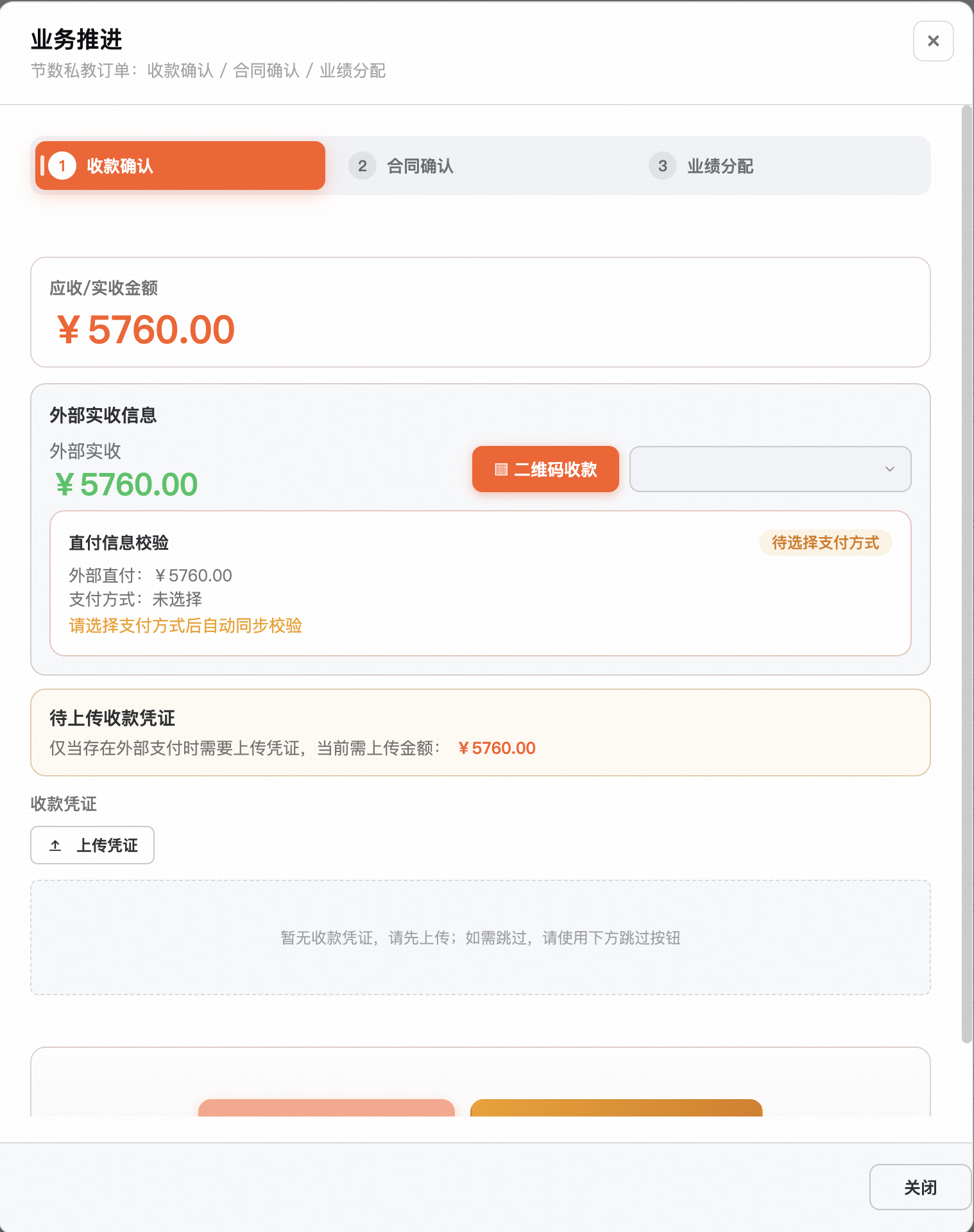
In gymker, payment confirmation is exactly this dialog — receivable / received amounts auto-matched, QR-code collection triggered with one click, receipts uploaded and archived. If information validation fails or no receipt is uploaded, this step doesn’t close.
📌 The payment confirmation step also has dedicated AI features for managers and finance — one-sentence ledger queries, automatic anomaly alerts, and more. Space is short here, so the next article will unpack them in full.
3. Pipeline step two: contract signing — this gate is here to cover the studio’s back
gymker deliberately built a contract confirmation step into the order workflow. First-time users often find it annoying: “the customer already paid, why are you gating me here?”
We’re not being difficult — we’re covering the studio’s back:
- No contract, no leverage when a dispute hits (this is exactly the “explanatory power at the contract level” discussed in the previous article, Customer Checkout);
- No contract, and member transfers between studios or between programs become unprovable in scope;
- No contract, and the order is just a payment record — not a legally meaningful “close.”
An order with no contract is an incomplete order — that’s why gymker makes this step mandatory. To push owners, managers, and coaches to actually sign the contract, rather than skipping past it the moment payment clears.
4. Pipeline step three: sales attribution — unavoidable if you’re in this for the long haul
The final step is sales attribution: allocating sales credit for this order across the sales rep / coach / manager involved.
This step is outright missing in many SaaS systems; the ones that have it usually let “the owner pick a ratio and move on.” At gymker, this is one of the core workflow steps — because once attribution is unclear, you walk straight into the bad habits the industry knows all too well.
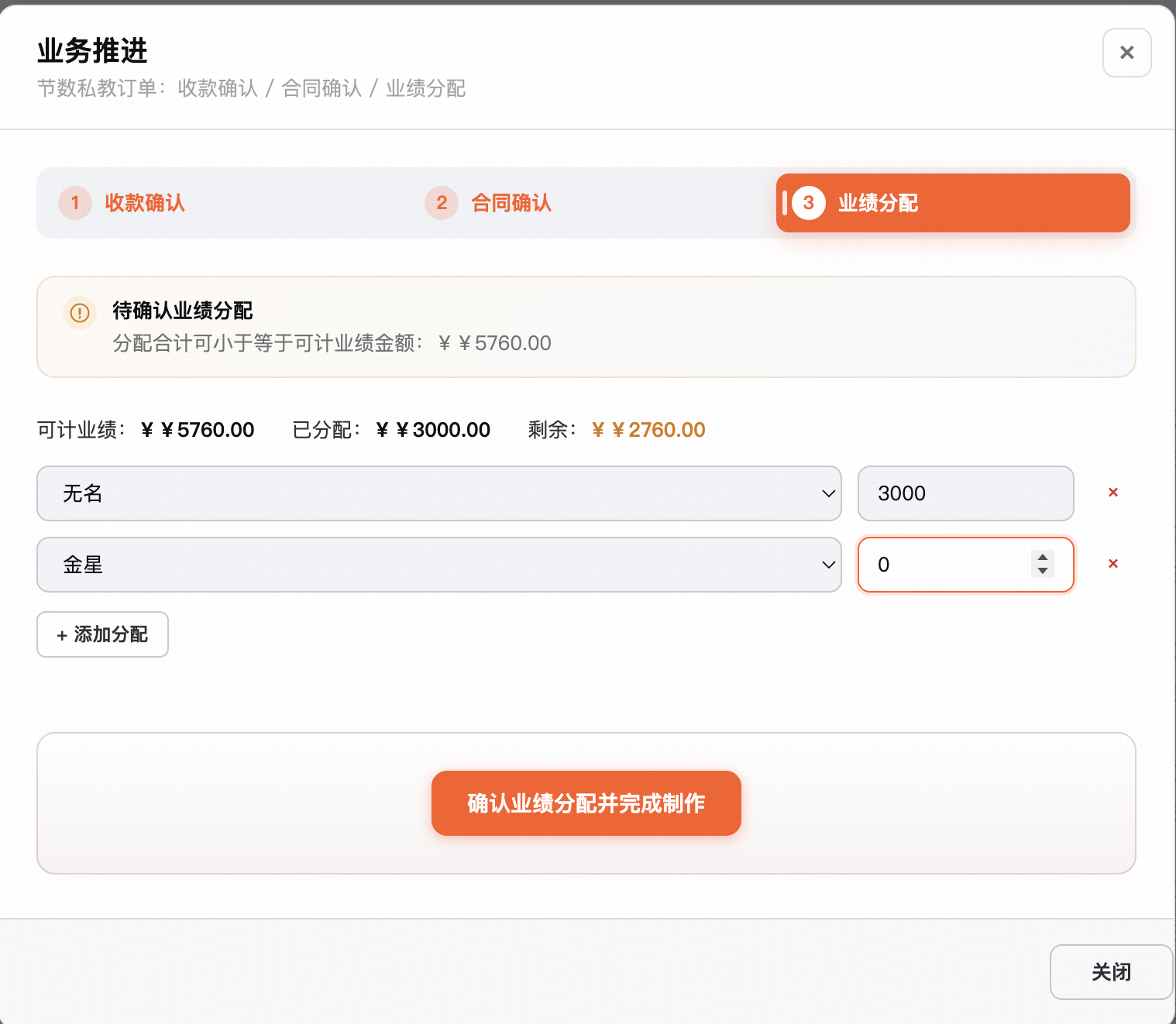
This is gymker’s sales attribution screen: allocatable ¥5,760, allocated ¥3,000, remaining ¥2,760 — until remaining hits zero, the “confirm sales attribution and complete creation” button below won’t fire, and the order stays stuck in “creating” forever. A small threshold on the surface, but the deeper effect is to move “who gets credit for this deal” out of the owner’s head and out of chat logs — and into the system.
🔮 Skipping sessions, stuffing orders, off-the-books PT… every one of these industry bad habits traces back to attribution that wasn’t held. There’s a lot to unpack here, so we’ll open a dedicated business series later to take them apart one by one, and explain how gymker uses workflow to pin them down. Stay tuned.
5. Building the workflow into the system as a “gate” is what operations mindset means
Summary · sales mindset vs. operations mindset
① Sales mindset ends at “the customer paid” — operations mindset ends at “the order is truly complete.”
② Creating an order is easy, the pipeline is the real work — creation just constructs the order; the pipeline determines whether it’s collected cleanly and stably.
③ Three pipeline steps, all interlocked — payment confirmation prevents profit leakage · contract signing makes disputes defensible · sales attribution keeps the team intact.
This Create → Pipeline workflow is one of the core flows gymker originated and refined through iteration. We won’t claim others have never had similar ideas, but turning it into a mandatory system where “you must complete every step before the order counts” is something gymker grew from the ground up.
In business, the customer paying is just the starting line. Closing every single order without a single leak is what gives a studio the staying power to last.